
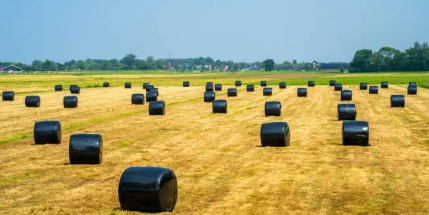
A bale can look perfectly sealed from ten metres away—and still be quietly losing value. Across Australian farms, a small tear, a weak seal, or a poorly stored roll of silage wrap can trigger a chain reaction of feed spoilage, wasted labour, and reduced livestock performance. Multiply that loss across hundreds or thousands of bales, and what first appears to be a minor packaging problem can become a six-figure mistake.
The hypothetical $100,000 figure is not a universal loss estimate, but it illustrates an important point: the real cost of silage failure is rarely limited to the price of the plastic itself. The bigger financial impact can come from everything that happens after the wrap fails.
The Expensive Problem Hidden Behind a Cheap Roll
When producers compare agricultural supplies, it is tempting to focus on the upfront price per roll. But the cheapest option may not necessarily deliver the lowest cost per usable bale.
The economics become more complicated when performance affects the quality of the feed inside.
● Spoilage creates direct losses: If oxygen enters through punctures, inadequate seals or damaged material, valuable forage can deteriorate before it reaches livestock.
● Labour is part of the equation: Rewrapping damaged bales, removing spoiled material and managing additional waste all consume valuable time.
● Feed quality has downstream consequences: Poorly preserved forage may reduce the nutritional value of the feed available to cattle, sheep and other livestock.
For an Australian producer managing a substantial number of bales, even a modest failure rate can have significant financial consequences. A bale that cannot be used represents more than lost forage. It can also mean lost harvesting costs, machinery time, fuel, labour and the opportunity cost of producing replacement feed.
That is why purchasing decisions should consider the total cost per successful bale, not just the sticker price of the wrapping material.
How Small Failures Become Big Farm Losses
The most expensive mistakes are often the ones that seem insignificant at first. A tiny puncture may go unnoticed during wrapping, while a damaged roll might be dismissed as an isolated issue.
However, when problems occur repeatedly, the financial impact can escalate quickly.
● Mechanical damage: Sharp objects, rough handling and contact with equipment can compromise the protective barrier around the bale.
● Storage conditions: Exposure to sunlight, heat and other environmental factors can affect the integrity of wrapped bales and unused material.
● Inconsistent application: Problems with wrapping tension, overlap, or the number of layers can create weak points that are difficult to identify immediately.
Australian conditions make this particularly relevant. Farms across regions such as South Australia, Victoria, New South Wales, Queensland and Western Australia operate in diverse climates, with intense sunlight and seasonal temperature fluctuations presenting practical storage challenges.
A producer may therefore spend considerable money creating high-quality forage, only to lose part of that investment because they treated the final preservation stage as an afterthought.
The lesson is straightforward: wrapping is not merely the final step of baling—it is part of the feed preservation system.
The $100,000 Mistake Is Usually a System Failure.
It is easy to blame a failed bale on one obvious cause. Perhaps there was a hole. Maybe the material was damaged. It could have been a machine setting.
But the biggest losses often emerge when several small weaknesses overlap.
Imagine an Australian livestock operation producing hundreds of bales. The farm purchases a lower-cost product, stores some rolls outdoors, experiences inconsistent wrapping performance and then discovers damaged bales weeks later. Each issue may appear manageable individually.
Together, they can create a substantial financial problem.
● The procurement mistake: Selecting materials based solely on price can overlook durability, consistency and suitability for the operation.
● Handling mistake: Poor storage and careless handling can damage material before it even reaches the baler.
● The monitoring mistake: Failing to regularly inspect wrapped bales can allow small problems to escalate into widespread spoilage.
This is where the concept of a “six-figure mistake” becomes useful. The loss may not arrive as one enormous bill. Instead, it can accumulate through dozens of smaller costs that are rarely tracked together.
By the time a farmer calculates wasted forage, additional feed purchases, labour and disposal costs, the original saving may look insignificant.
Turning Silage Preservation Into a Profit Protection Strategy
The good news is that preventing large losses does not necessarily require complicated technology or an expensive overhaul of farm operations. It starts with treating forage preservation as a measurable business process.
Farmers can begin by examining the complete journey from purchase to feeding.
● Track performance: Record how many bales are produced, how many are damaged and how much spoilage occurs over time.
● Inspect regularly: Check stored bales for visible damage and investigate recurring problems rather than treating each damaged bale as an isolated incident.
● Evaluate suppliers on value: Consider consistency, product performance and technical support alongside the initial purchase price.
The same principle applies when choosing an agricultural film technology for different farming operations. A high-volume producer may prioritise efficiency and consistency, while a smaller farm may place greater emphasis on ease of handling and storage. The “best” product is therefore not necessarily the lowest-priced one—it is the one that delivers the best overall preservation outcome for the farm’s specific requirements.
For Australian producers, this approach can also support more sustainable resource use. Every bale successfully preserved represents forage, water, fertiliser, fuel, machinery hours and labour that do not need to be replaced unnecessarily.
Conclusion: Find the Hidden Leak Before It Becomes a Major Loss
The most dangerous farm expenses are not always the ones appearing prominently on an invoice. Sometimes, they are hidden inside spoiled bales, wasted forage, extra labour and feed that has to be purchased again.
The real warning behind the $100,000 mistake is not that every farm will lose that amount. It is those small preservation failures that can compound quickly when multiplied across a large operation.
The next step is simple: audit your current silage process from purchase and storage through to wrapping, bale handling and final feeding. Identify where losses occur, calculate their true cost and compare that figure against the savings achieved by your current approach.
Once you know where the money is leaking, you can make a smarter decision about your silage wrap—and potentially protect far more value than the material itself costs.